Niacinamide vs Vitamin C: Which Active Is Right for Your Product Line?
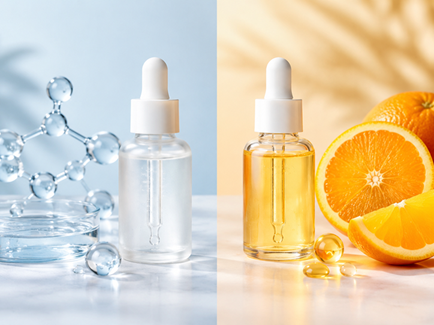
Both niacinamide and vitamin C have strong consumer recognition, proven efficacy, and broad formulation potential. But they behave very differently in a commercial product line.
The right choice depends on target market, product format, cost structure, stability requirements, regulatory claims, and supply chain reliability.
1. The two actives at a glance
| Factor | Niacinamide | Vitamin C (L-Ascorbic Acid) |
|---|---|---|
| INCI | Niacinamide | Ascorbic Acid |
| Solubility | Water-soluble | Water-soluble |
| Optimal pH | ~5–7 | ≤3.5 for LAA |
| Typical use level | 0.5–5% (up to 10%) | 5–20% |
| Stability | High | Low in water; prone to oxidation |
| Cost | Low | Medium to high for LAA; derivatives vary |
| Formulation difficulty | Easy | Challenging |
| Best formats | Cleansers, toners, serums, creams, masks, SPF | Serums, ampoules, boosters, anhydrous systems |
| Main claims | Oil control, pores, barrier, even tone | Antioxidant, brightening, spots, collagen support |
| Sensitive skin | Generally well tolerated | May sting; derivatives are gentler |
| Compatibility | Broad | Needs chelators, antioxidants, low oxygen, opaque/airless packaging |
2. Why this matters for B2B product lines
Niacinamide is often the volume driver. It is cost-effective, stable, easy to formulate, and suitable for a wide range of skin types and product formats.
Vitamin C is often the premium driver. It supports higher price points and strong marketing claims around brightening, antioxidant protection, and anti-aging.
For procurement teams, the key difference is not just efficacy — it is manufacturability, stability, packaging cost, and regulatory claim support.
3. Formulation and manufacturing considerations
Niacinamide
- • Compatible with most surfactants, emollients, UV filters, and preservatives.
- • Works well in cleansers, toners, essences, serums, lotions, creams, and masks.
- • Generally stable across typical cosmetic pH ranges.
- • Low irritation risk at common use levels.
- • Cost-efficient for mass-market and private-label lines.
Watch-outs:
- • Very high concentrations can cause flushing or irritation in some users.
- • At low pH and high temperature, niacinamide can hydrolyze to nicotinic acid, which may increase flushing risk.
- • Claims should be supported by formula-level testing, not just raw material data.
Vitamin C
- • L-Ascorbic Acid requires low pH, typically ≤3.5, for optimal skin penetration.
- • Highly prone to oxidation, browning, and loss of activity.
- • Requires chelating agents, antioxidant partners, low-oxygen processing, and protective packaging.
- • Often needs opaque, airless, or single-dose formats.
- • Derivatives can improve stability and reduce irritation, but potency and claim strength may differ.
Common derivatives:
- • Sodium Ascorbyl Phosphate (SAP)
- • Ascorbyl Glucoside (AA2G)
- • Magnesium Ascorbyl Phosphate (MAP)
- • 3-O-Ethyl Ascorbic Acid
- • Tetrahexyldecyl Ascorbate (THD)
Watch-outs:
- • LAA and niacinamide have conflicting pH preferences in the same aqueous formula.
- • Vitamin C products require rigorous stability and photostability testing.
- • Packaging compatibility is critical. A poor package can kill an otherwise good formula.
4. Can they be combined in one product?
Yes, but not always in a simple aqueous formula.
The main issue is pH conflict:
- • L-Ascorbic Acid needs an acidic environment.
- • Niacinamide is most stable around pH 5–7.
- • At low pH and elevated temperature, niacinamide can convert to nicotinic acid, increasing irritation risk.
Practical B2B options:
- 1. Separate AM/PM products — vitamin C in the morning, niacinamide at night.
- 2. Use vitamin C derivatives that work at higher pH.
- 3. Dual-chamber or anhydrous formats — higher cost, but strong marketing story.
- 4. Separate SKUs — the most common and commercially reliable approach.
For most brands, separate products are easier to stabilize, easier to claim, and easier to scale.
5. Product line strategy: when to choose which
| Business goal | Recommended active | Best formats | Notes |
|---|---|---|---|
| Oily / acne-prone line | Niacinamide | Cleanser, toner, serum, moisturizer, SPF | Cost-effective, broad appeal |
| Brightening / anti-aging line | Vitamin C | Serum, ampoule, day cream, booster | Premium positioning |
| Sensitive skin line | Niacinamide + VC derivatives | Cream, lotion, serum | Lower irritation risk |
| Full regimen | Both, separated AM/PM | AM: vitamin C; PM: niacinamide | Strong retail story |
| Cost-sensitive mass line | Niacinamide | Cleanser, lotion, serum | Easy to scale |
| Premium clean beauty | Stabilized vitamin C | Airless serum, ampoule | Higher packaging cost |
Most commercially successful architecture:
- • AM: Vitamin C serum + moisturizer + SPF
- • PM: Niacinamide serum + moisturizer
This gives you two hero SKUs, clear usage education, and fewer formulation conflicts.
6. Regulatory and claims checklist
Before choosing an active, confirm the target market requirements.
- • EU: Avoid unsubstantiated “whitening” claims. Use “evens skin tone,” “radiance,” or “brightening” with support.
- • US: Distinguish cosmetic claims from drug claims. Brightening can be cosmetic; treating melasma may be drug-like.
- • ASEAN: Check local cosmetic notification requirements.
- • China: Whitening products may require special registration. Verify claims and testing early.
Documentation to request from suppliers:
- • COA, MSDS, TDS
- • Heavy metals and microbial limits
- • Stability and compatibility data
- • Clinical or instrumental claim support
- • Allergen statements
- • Vegan, halal, kosher, or COSMOS certifications if needed
7. Sourcing and procurement checklist
For B2B buyers, the active is only one part of the decision.
Ask your supplier or manufacturer:
- • What is the recommended use level and pH range?
- • Is the raw material stable in your target formula?
- • What packaging is required for stability?
- • What is the accelerated and real-time stability data?
- • Can you provide formula-level efficacy or claim support?
- • What is the MOQ, lead time, and price volatility?
- • Are there alternative derivatives with better stability or cost?
- • Can you support private label, custom formulation, or white label?
Niacinamide is generally easier to source, more stable, and lower cost.
Vitamin C offers stronger premium potential but requires more R&D, packaging, and regulatory investment.
8. Bottom line for B2B buyers
- • Niacinamide is the reliable volume active: stable, cost-effective, multi-functional, and suitable for many formats.
- • Vitamin C is the premium active: strong brightening and antioxidant story, but higher formulation and packaging demands.
- • Best commercial approach: separate AM/PM products or use stabilized derivatives.
- • Do not assume one active fits every SKU. Match the active to the format, target consumer, and claims.
- • Validate with stability, compatibility, and claim testing before scaling.
The winning product line is not about choosing the “stronger” ingredient.
It is about choosing the active that fits your market, margin, manufacturing, and regulatory strategy.
Interested in our products?
Let's discuss how we can help your brand grow — formulation, OEM/ODM, and compliance, all in one place.
Send Inquiry